Melissa Powell

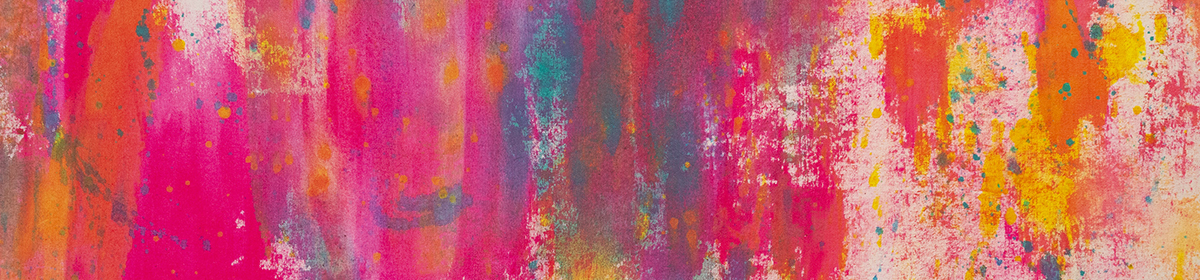
traces of time_M_PowellTraces of time, 2012, pigment ink on cotton rag

Today I visited Vestige II by Melissa Powell at Anita Traverso Gallery.

I met Melissa last year when visiting my artist friend Mars in Natimuk, so I was curious to see her work. It was absolutely amazing! Beautiful aerial photography of the landscape, mainly in the Wimmera. Paddocks of canola embellished with curving plough lines like a yellow plush carpet. The mineral colours and abstract shapes of a salt lake. The traces left on the earth by farming, mining, erosion, fire and flood. And Droughtbreaker, a dark photograph of the delicate tracery of dead trees contrasting with dark flood water. Her photographs have a beautiful meditative quality and give us a bird’s eye view of the land.

Droughtbreaker_M_PowellDroughtbreaker, 2011, pigment ink on cotton rag

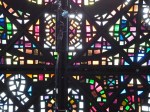
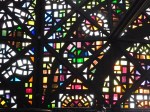
NGV leadlight ceiling

I visited the NGV St Kilda Road today with a friend from Adelaide and we spent some time lying on the couches in the Great Hall admiring the leadlight ceiling by Leonard French. The hall is a beautiful cathedral-like space bathed with light and the coloured glass mosaic reminds me of a kaleidoscope. It’s the largest stained glass ceiling in the world (according to Wikipedia).

Talking about art

There is a lot of crap written about art and I love the latest post on the MONA blog by Elizabeth Mead.

There’s no gold star for ‘getting it’ or even enjoying it.

She says knowing about the work, the artist, why it was made, and why David Walsh bought it, can be interesting, but isn’t essential –

And so why stare at all? You’ll give yourself a headache. Instead, I recommend just taking these things, these history-less objects, as you find them, sitting, well lit, on a plinth or whatever, in the gallery. There’s no hope of recovering their context, some germ of origin for existence. They exist just for you now. Maybe they have something to teach you – but don’t just take them at their word. Make it up for yourself. If there’s something there for you, suck it up, and move on. If there’s nothing just push past to the next piece, or go and have a drink at the bar. The point, the only point, is to have something – a thought, feeling, memory or intention – slide into place, or shift its position.

She says about the contextual essays available on the O devices:

We’re sure the whole thing’s a bit of a farce, which is why we call those essays ‘Art Wank’, and why we also write ‘Gonzo’ pieces on the art, which do away entirely with the concept of objectivity. The writing of history – recording of known or debated facts, the selecting of events and people deemed relevant to your appreciation of the object – is just one voice with which to speak about art, and one you should never take fully at its word. The only truthful way to speak about the present or the past is in a voice that announces, in its every utterance, its lies and silences, its weaknesses and desire to manipulate you, the listener, for its own ends.
Choi Jeong Hwa

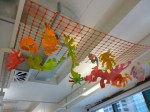
Korean installation artist Choi Jeong Hwa is awesome!

“I work with things we use every day, and I try and turn them into art” he says. “Plastic doesn’t decompose. Even when it’s old, it looks like new, and it’s recyclable. That’s why I call plastic my ‘master'”.

What we leave behind…

I visited our exhibition again… and noticed this on the studio floor. It’s from a painting I did with orange fluoro paint and glitter and the painting fell on the floor and Xavier made it into a drawing.

It made me think of the signs and evidence we leave behind us, that show we were here, both tangible and intangible.

The words of Karen Blixen from Out of Africa came to my mind…
If I know a song of Africa, does Africa know a song of me? Will the air over the plain quiver with a color that I have had on… or will the eagles of the Ngong Hills look out for me?

Yes, I’m getting sentimental about finishing the year, and leaving my studio.

Kieran Stewart

Kieran Stewart was our Context and Culture lecturer at VU and his enthusiasm for art is infectious.

He’s also a visual artist who works across the mediums of video, image making and sculptural installation. Kieran explores concepts of labour, systems of commercial promotion and gross capital production.

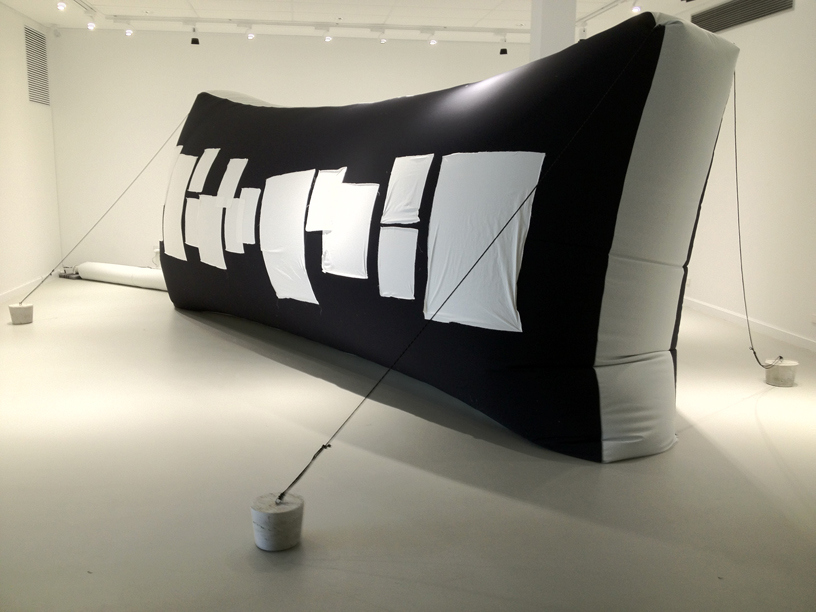
Kieran makes inflatable sculptures and his Occupy Nothing is a wall that deflates when someone approaches. The work re-inflates when is stops sensing movement. Kieran’s work often has a playful and unusual quality that I like.

Powered up and broken was a modified ATM placed in a gallery that printed the title and description of work on a receipt when you attempted to withdraw cash. This is one of Kieran’s favourite works and I love the craziness of it. More about Kieran here.