Instagram is a great platform for visual artists and looking at art. I’ve found some amazing artists there while scrolling around looking for inspiration. Three of my favourite insta artists are:
Melissa McGill is an abstract artist from Las Vegas, Nevada. Her work combines painting, and drawing in a free sketchy way and her use of colour is subtle. She works on canvas and paper and lives in the desert. I love the freedom and the layers of texture and colour in her paintings.
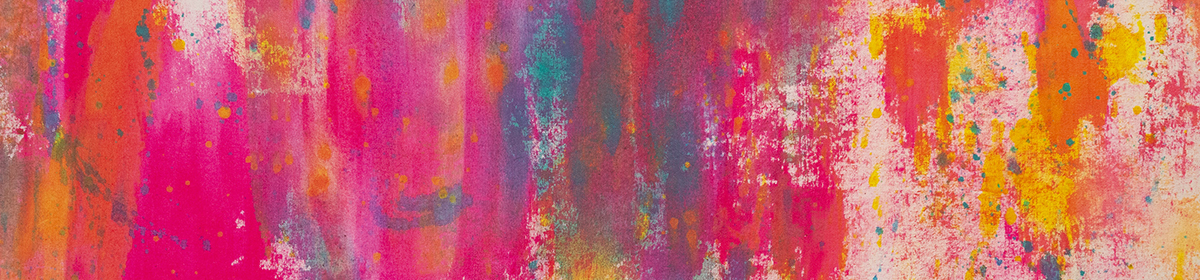
Claire des Jardins, another abstract painter, uses bright juicy colour and often pours and drips paint onto her canvases. She lives in Quebec, Canada and paints full time in her studio. Her work is exuberant and makes me feel happy.
Melbourne artist and illustrator Miranda Costa or ‘McDrawn’ draws and paints realistic and fantasy images, often of birds and flowers. Her work is delicate, painstaking and inspired by nature, and very beautiful.
I recently came across an 80 year old female artist I’d never heard of. She was a pioneer of the feminist art movement in the 1960s and 70s in the US.
Her early working life was lonely and she was mostly broke. “I didn’t make myself an outsider,” she says. “The art world made me an outsider. Of course, isolation is essential to the creative act. You have to be with yourself, with your ideas. Virginia Woolf talked about it as fishing: you sit on the shore, you drop your line, and you wait for the fish to jump. But I also had to protect myself from the craziness, all the antagonism, around me. It was difficult. I’m not going to say it was anything else. Not everybody could have managed it.”
What did she sacrifice along the way? “Children. There was no way on this earth I could have had children and the career I’ve had. But you know what? I don’t care how much I had to give up. This was what I wanted. You have to make choices. You can’t have everything in life.”
The Dinner Party – Judy Chicago 1974–1979
As for her elaborate 1979 megasculpture The Dinner Party, a provocatively feminist work which celebrates the lives and work of 1,038 notable women, you can forget what the critics say (the late Robert Hughes called it: “Mainly cliché… with the colours of a Taiwanese souvenir factory”; Hilton Kramer of the New York Times called it: “Very bad art… failed art… art so mired in the pieties of a cause that it quite fails to capture any independent artistic life of its own”
With three retrospective exhibitions in the UK in 2012 and increasing acclaim for her work in the past decade, she has finally achieved the respect she deserves. Her famous work The Dinner Party comprises triangular table laid with 39 place settings, each one designed to reflect the accomplishments of a woman – included are Hildegard of Bingen, Mary Wollstonecraft and Virginia Woolf. Beneath the table is a ‘heritage floor’, the names of a further 999 women (Catherine of Aragon, Colette, Clytemnestra) inscribed on its tiles. It sounds uncontroversial, celebrating, as it does, the history of women through applied arts such as embroidery and china painting. But then you look at the plates. Each one is decorated with a symbol that resembles a vulva. Depending on your point of view, this is either reductive, vulgar and semi-pornographic, or it’s celebratory, taboo-breaking and bracingly political.
Art-world statistics, in particular, still make for depressing reading. Work by women artists comprises just 3–5% of major permanent collections in the US and Europe. “It’s alarming. In our institutions, women are still an add-on to a male-centred curriculum,” she says.
Born in England to a wealthy family, artist Leonora Carrington (1917–2011) lived most of her life in Mexico and died aged 94 in Mexico City. She was a rebellious girl, expelled from two schools, discouraged from pursuing art by her parents, but finally allowed to attend art school in London.
She became involved in the Surrealist art movement, meeting Max Ernst and moving to France to live with him in 1937. When Ernst was interned as an enemy alien in 1939, Carrington left France for America via Madrid, where she had a spectacular mental breakdown and spent months in an asylum.
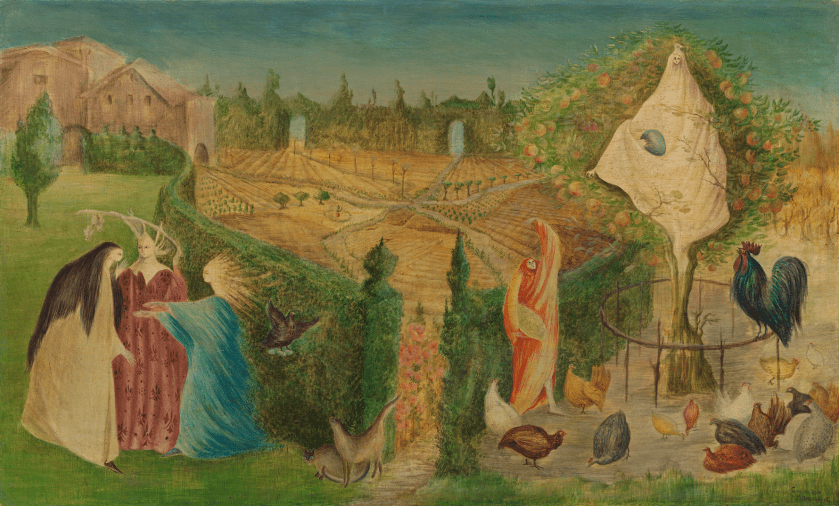
Pastoral, 1950
The experience of emotional suffering, painful medical treatment, and forced incarceration profoundly affected her, and despite the trauma of this period, it led Carrington to understand the alchemical potential of the body, an idea that would deeply inform her later work. When she learned that her family had arranged for her to stay in another mental institution in South Africa—presumably for the long term—Carrington hatched an escape plan, enlisting help from a Mexican diplomat she had met through Pablo Picasso. Carrington and the diplomat quickly married in Lisbon, and secured boat passage to Mexico.
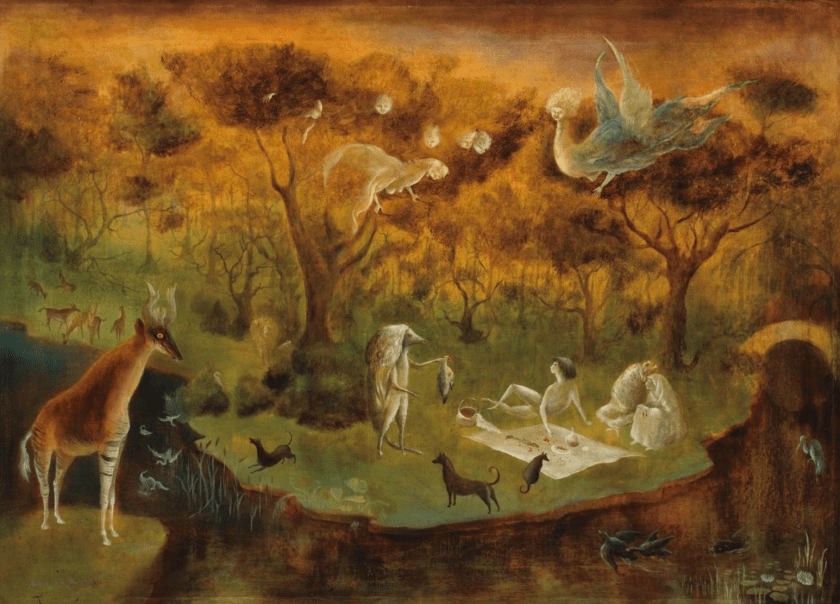
Green Tea, 1942
In Europe, the rise of fascism meant restricted movement and ever-tighter borders, but Mexico flung its doors open to the world. An artistic and intellectual community flourished: European artists like André Breton, Remedios Varo (who became a great friend to Carrington), as well as revolutionaries like Leon Trotsky, encountered Mexican artists such as Diego Rivera and Frida Kahlo.
Carrington’s paintings explore transformation, with a menangerie of animals, humans, and hybrid creatures. She often painted a white horse or a hyena as a symbol of herself in these magical compositions. In her paintings, bodies are unstable, moving between genders, species, life, and death, but her paintings have a dreamy amorphous quality, they are not macabre or dark. They are like strange dreams or fantastic portals to another reality.




 kerynrobinson